
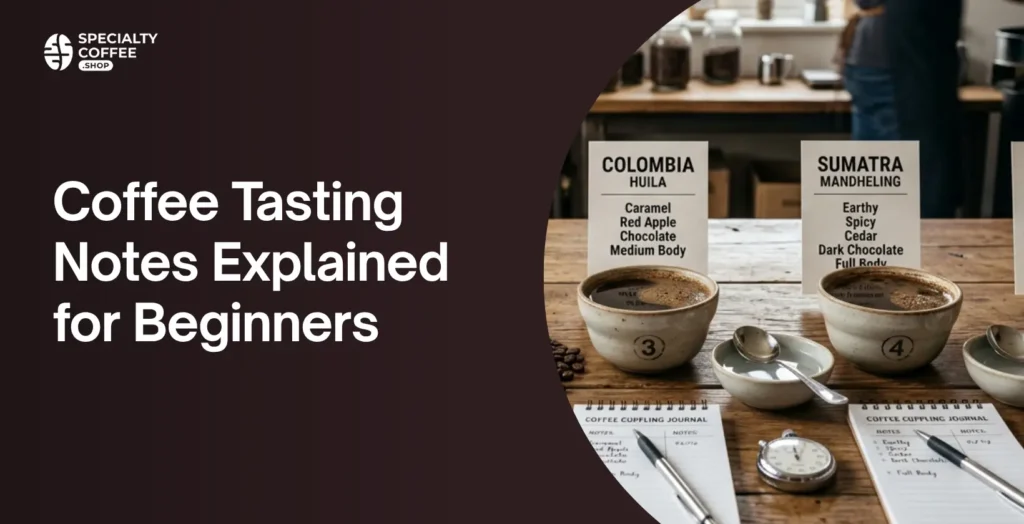
Tasting notes are the short flavor descriptors printed on a bag of coffee, words like blueberry, caramel, or jasmine that hint at how the cup will taste. They exist because good coffee carries distinct flavors created by its origin, variety, and processing. Reading them well saves money. This guide explains what the notes mean, where they come from, and how to shop with them.
Coffee tasting notes are descriptive terms for the aroma, flavor, acidity, body, and aftertaste found in a brewed coffee, drawn from a shared sensory vocabulary such as the Coffee Taster’s Flavor Wheel rather than added ingredients or artificial flavoring. These flavors come from naturally occurring compounds shaped by the bean’s species, growing altitude, processing method, and roast level.
What Are Coffee Tasting Notes?
Coffee tasting notes are a standardized way to describe flavors already present in coffee, not flavors added during roasting or brewing. The vocabulary is anchored by the Coffee Taster’s Flavor Wheel, first published in 1995 and rebuilt in 2016 by the Specialty Coffee Association in collaboration with World Coffee Research.
That wheel is based on the WCR Sensory Lexicon, a reference library of 110 aroma, flavor, and texture attributes. Professional tasters, often certified Q-graders, score coffee on aroma, flavor, aftertaste, acidity, body, balance, and sweetness. You can explore the Specialty Coffee Association’s research and the World Coffee Research sensory lexicon for the full framework.
How Do Coffee Tasting Notes Form in the Cup?
Coffee tasting notes form from four main factors: the plant species and variety, the altitude where the coffee grew, how the cherry was processed, and how the beans were roasted. Species sets the ceiling. Arabica carries more sugar, acidity, and aromatic complexity than robusta, which is why nearly all named notes come from arabica. Altitude then concentrates flavor.
On high slopes like the western side of Mount Elgon, where our Uganda Bugisu grows at roughly 1,500 to 2,300 meters, cool nights slow cherry maturation and build sweetness and acidity. Processing shapes the final print. Washed coffees taste cleaner and brighter, while natural coffees taste fruitier and heavier, as our guide to coffee processing methods explains in detail.
Common Flavor Families and What They Mean
Most coffee tasting notes fall into a handful of flavor families, and learning the families makes any bag easier to read. The six you will meet most are fruity, floral, sweet, nutty or cocoa, spice, and roast-driven flavors. Each family maps to real origins and processing styles.
| Flavor family | Example notes | Often found in |
|---|---|---|
| Fruity (berry, citrus) | blackcurrant, blueberry, lemon | East African washed coffees |
| Floral | jasmine, bergamot, rose | high-grown Ethiopian arabica |
| Sweet | caramel, brown sugar, honey | washed Colombian arabica |
| Nutty and cocoa | almond, hazelnut, dark chocolate | washed African and Central American lots |
| Spice | cinnamon, clove, black pepper | some naturals and darker roasts |
| Roast-driven | toast, malt, smoke | medium to dark roasts |
You can taste these families side by side. A floral, tea-like cup defines Ethiopia Yirgacheffe, a sharp blackcurrant acidity marks Kenya AA, and a balanced, sweet profile is typical of Colombia Huila.
How Does Roast Level Change the Cup Profile?
Roast level changes coffee tasting notes by trading origin flavors for roast flavors. Lighter roasts preserve fruit, floral, and acidic notes; darker roasts add caramelized, chocolatey, and smoky notes while muting origin character.
The turning point is first crack, around 196°C (385°F), when sugars begin to caramelize. A light roast keeps the bright, distinctive cup profile prized in specialty coffee. A medium roast balances origin and body. A dark roast pushes toward bitterness and roast tones, which is why dark roasts of different origins can taste alike.
Roast level is only half of it; freshness is the other half. Tasting notes are easiest to pick out in premium specialty coffee roasted to order, opened between 4 and 28 days after the roast date, before the aromatics that carry fruit and florals start to fade.
Single-Origin vs Blend: How Tasting Notes Differ
Single-origin coffees usually show clearer, more distinctive coffee tasting notes because they come from one place, while blends prioritize balance and consistency over origin clarity. A single origin is traceable to a country, region, or even a single farm, so its flavors reflect that specific terroir. Learn more in our explainer on single origin coffee.
| Factor | Single-origin | Blend |
|---|---|---|
| Origin clarity | High, tied to one place | Low, several origins mixed |
| Typical notes | Distinct, expressive | Balanced, rounded |
| Best for | Exploring flavor, pour-over | Everyday espresso, consistency |
| Consistency | Varies by harvest | Stable year-round |
For cafés and roasters buying at volume, our bulk coffee beans guide explains how to keep flavor consistent across larger orders.
How to Taste Coffee at Home in Six Steps
You can identify coffee tasting notes at home with a simple cupping routine that takes about 15 minutes and needs only fresh coffee, a grinder, hot water, a cup, and a spoon. Follow these steps:
- Grind 12 grams of fresh coffee medium-coarse into a cup.
- Smell the dry grounds and note the first aromas.
- Pour about 200 milliliters of water just off the boil, near 93°C (200°F).
- Wait four minutes, then break the crust with a spoon and smell again.
- Skim the foam, let the coffee cool slightly, then slurp a spoonful to spread it across your palate.
- Compare what you taste to the flavor families above and to the notes on the bag.
For deeper technique on grind, water, and extraction, Barista Hustle offers detailed courses.
Common Mistakes Beginners Make With Tasting Notes
The most common mistake is expecting tasting notes to taste like added flavoring; the descriptors are subtle associations, not sugary syrups. A blueberry note is a faint impression, not a blueberry muffin. Other frequent errors include:
- Brewing with bad water or the wrong ratio, which flattens delicate flavors.
- Buying pre-ground or stale coffee, which loses aromatics within weeks.
- Judging origin notes in a dark roast, where roast flavors dominate.
- Comparing coffees across very different roast levels or brew methods.
How to Choose Coffee Using Its Tasting Notes
Choose coffee by matching its coffee tasting notes to flavors you already enjoy, then confirming origin, process, and roast date. If you like chocolate and low acidity, look for naturals or medium-dark roasts. If you like bright, fruity cups, choose washed East African coffees at a light roast. Always check the roast date for freshness, and favor sellers that publish origin and processing details, since traceability is what makes a note trustworthy.
Frequently Asked Questions
What is the difference between tasting notes and added flavors?
Coffee tasting notes describe natural flavor compounds already present in the roasted bean, not syrups or additives. A note like blueberry means the coffee produces a blueberry-like aroma or taste through its own chemistry, shaped by variety, altitude, and processing. Flavored coffees, by contrast, are sprayed with external flavoring after roasting.
How accurate are the tasting notes printed on a coffee bag?
They are moderately accurate but subjective, since they reflect one roaster’s palate under specific brewing conditions. Trained tasters calibrate against a shared reference like the Coffee Taster’s Flavor Wheel, yet your water, grind, and method will shift what you detect. Treat printed notes as a reliable guide, not a guarantee.
Why can’t I taste the notes listed on my coffee?
Usually the cause is brewing or freshness, not the coffee itself. Stale beans, water that is too hot or too cool, an off grind size, or a weak coffee-to-water ratio all flatten delicate notes. Buy whole beans, use recently roasted coffee, and dial in your brew to reveal them.
Is arabica better than robusta for flavor?
Yes, for complex flavor arabica is generally preferred. Arabica has higher natural sugars and acidity and more aromatic compounds, giving the fruity, floral, and sweet notes typical of specialty coffee. Robusta tastes stronger and more bitter, with earthier, woody, and grainy notes and less nuance in the cup.
Does a darker roast produce stronger flavor notes?
No, a darker roast produces stronger roast flavors, not stronger origin notes. Heat caramelizes sugars and adds smoky, bitter, chocolatey character while burning off the delicate fruit and floral compounds that carry origin identity. For clear, distinctive origin notes, choose a light to medium roast instead of a dark one.
Should beginners buy single-origin or blends to learn coffee flavors?
Beginners should start with single-origin washed coffees to learn coffee tasting notes, because one origin produces clearer, more distinct flavors that are easier to identify. Blends smooth several coffees into a balanced cup, which hides individual characteristics. Once your palate develops, blends become a rewarding study in balance and consistency.
Conclusion
Learning coffee tasting notes turns coffee buying from guesswork into a repeatable, informed choice built on aroma, acidity, body, and origin. The clearest flavors come from carefully sourced single-origin lots, which is where curated specialty coffee from major producing countries, backed by quality verification and traceability, gives beginners a dependable starting point well worth trusting.
Ready to taste the difference for yourself? Explore the full range of single-origin coffees at SpecialtyCoffee.Shop, where you can compare origins side by side, from the dark chocolate and citrus of Uganda Bugisu to brighter East African lots. Browse the full collection, request a sample, and see exactly what is available before you commit today.


