
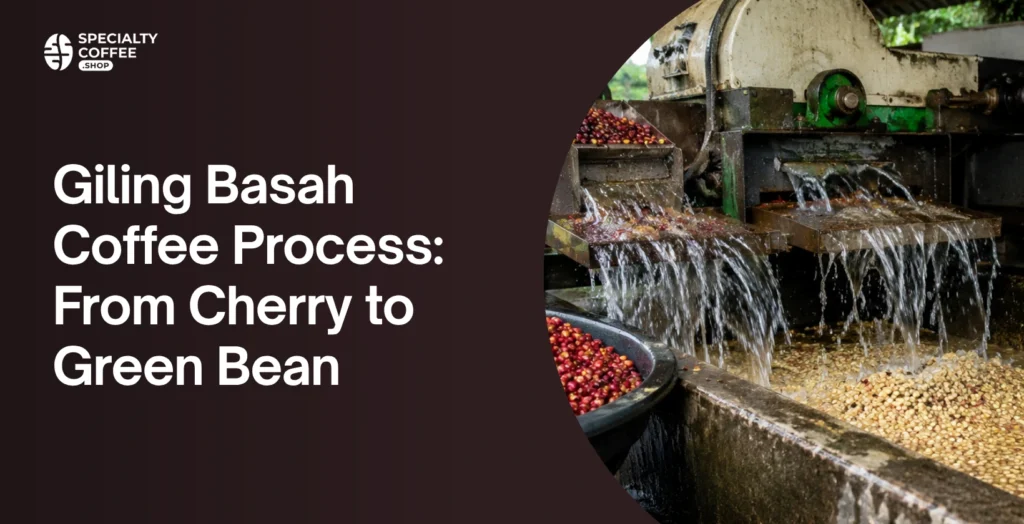
Giling basah coffee process gives Sumatran and Sulawesi coffee its unmistakable earthy weight. The method exists because Indonesia’s climate rarely allows the slow, even drying that washed coffee needs. For roasters and buyers, knowing how it works explains why these beans look blue-green, roast unevenly, and taste like almost nothing else on the shelf. This guide walks through the method stage by stage, from ripe cherry to green bean.
The giling basah coffee process is an Indonesian wet-hulling method that removes the parchment layer while the bean still holds 30 to 40 percent moisture, then dries it to 12 to 13 percent, producing a full-bodied, low-acid cup with earthy and herbal notes.
What Is the Giling Basah Coffee Process?
Giling basah is the Indonesian name for wet hulling, and it translates literally as “wet grinding.” The process removes the coffee’s parchment layer early, while the bean is still soft and wet, rather than at the dry, storage-stable stage used everywhere else. That timing is the whole point.
In most origins, coffee rests inside its parchment until it reaches 10 to 12 percent moisture, the level the SCA Coffee Standards treat as stable for green coffee. The giling basah coffee process breaks that rule on purpose. Hulling at high moisture, followed by fast final drying, is what gives these beans their density, their color, and their reputation. For a deeper technical breakdown, see our guide to the wet-hulled coffee process.
How Does Wet Hulling Shape the Cup?
Wet hulling builds body and mutes acidity. Removing the parchment while the bean is wet lets moisture and enzymes keep working, and the fast, hot drying that follows pushes the cup toward cedar, tobacco, and baking spice rather than fruit and citrus.
On the roasting bench, the difference shows before first crack. Wet-hulled greens arrive blue-green and slightly swollen, with less uniform density than a clean washed lot, so they take color faster and reward a medium to medium-dark roast. The giling basah coffee process suits darker development because there is little delicate acidity to lose. Work published by Specialty Coffee Association Research ties processing choices directly to sensory outcomes, which is why the same variety can taste so different here.
Which Coffee Origins Use Wet Hulling?
Wet hulling is almost exclusive to Indonesia. Sumatra leads, with Gayo in Aceh, Mandheling, and Lintong near Lake Toba, followed by Toraja in Sulawesi and small volumes in Papua. A little appears in Vietnam.
Indonesia ranks among the world’s top-five coffee producers (USDA and ICO data, 2025), and most of its Arabica moves through wet hulling. These origins share a warm, constantly humid climate where full parchment drying is impractical. Gayo Arabica grows at roughly 1,100 to 1,700 meters and is the country’s most traded specialty grade. The giling basah coffee process is a regional adaptation, not a global one, so variety guidance from World Coffee Research helps when comparing origins. For contrast, a washed lot like Uganda Bugisu from the Mount Elgon slopes shows the clean, high-acidity profile wet hulling deliberately moves away from.
The Steps From Cherry to Green Bean
The giling basah coffee process follows a recognizable sequence, compressed to beat the rain. Each stage trades some drying stability for speed.
- Harvest and sort. Farmers hand-pick ripe cherries and float-sort out defects, usually delivering to a collection point within hours.
- Pulp. Small hand-cranked or motor pulpers strip the outer skin, leaving parchment coated in mucilage.
- Brief fermentation and wash. A short fermentation loosens the mucilage, then the coffee is washed and drained.
- Partial drying. The parchment coffee, locally called gabah, dries only to about 30 to 40 percent moisture.
- Wet hulling. Mills hull the soft, damp parchment early, exposing the bare green bean, now called labu.
- Final drying. The naked beans dry fast to 12 to 13 percent and turn their signature blue-green.
Because the bean spends its final drying without parchment, the giling basah coffee process moves coffee from cherry to export port in under a month, far quicker than the roughly three weeks washed coffee alone can need just for drying.
Wet Hulling vs Washed and Natural Processing
Wet hulling, washed, and natural processing produce three different cups from the same cherry. The table below maps the core differences that matter to a buyer.
| Attribute | Wet Hulling (Giling Basah) | Washed | Natural |
|---|---|---|---|
| Parchment removed at | 30 to 40 percent moisture | 10 to 12 percent | 10 to 12 percent |
| Acidity | Low | High, clean | Medium |
| Body | Heavy, syrupy | Light to medium | Full, round |
| Typical notes | Earthy, cedar, spice | Floral, citrus, tea-like | Berry, fruit, wine |
| Main region | Indonesia | Global | Global |
Compared with those methods, the giling basah coffee process trades brightness for weight, which is why it rarely tastes like its terroir the way a washed coffee does. For the full landscape, see coffee processing methods, and for an experimental route that pushes flavor the other direction, read our notes on wine process coffee.
What Roasters and Buyers Should Watch For
Wet hulling carries real quality risks that buyers should weigh. Because the bean loses its protective parchment while still wet, it is exposed to mold, ambient yeast, and uneven drying, which can show up as musty, phenolic, or sour notes and a mottled, patchy look in the green.
Two habits protect a purchase. First, taste the current lot before committing to volume, since wet-hulled quality varies batch to batch. Second, judge it on its own terms, not against a bright washed coffee like Ethiopia Yirgacheffe. Buyers new to the giling basah coffee process should expect earth and body, not clarity. Traceability to a specific region and mill is the strongest signal that defects were controlled, because careful moisture management at each handoff is what separates a clean wet-hulled lot from a flawed one.
Frequently Asked Questions
What does “giling basah” mean in English?
Giling basah translates from Indonesian as “wet grinding,” better known in English as wet hulling. It describes removing the coffee’s parchment layer while the bean is still wet, at around 30 to 40 percent moisture, rather than the dry stage used in washed and natural processing. The name refers only to that hulling step.
Is the giling basah coffee process the same as washed processing?
No. Washed processing removes the parchment only after the bean dries to 10 to 12 percent moisture, while wet hulling removes it at 30 to 40 percent. That single difference reshapes the cup, giving wet-hulled coffee heavy body and low acidity instead of the bright, clean acidity that defines a washed profile.
Why does giling basah coffee taste earthy and low in acidity?
Hulling the bean while wet, then drying it fast without parchment, is the main cause. The exposed green absorbs ambient character and ages quickly under intense sun, developing cedar, wood, and spice notes. High moisture during hulling also builds a denser, syrupy body while suppressing the fruity acidity that washed coffees preserve.
What moisture level is coffee hulled at during wet hulling?
Around 30 to 40 percent moisture, far above the 10 to 12 percent used in most methods. During the giling basah coffee process, mills partially dry the parchment, then hull the soft bean early and finish drying the exposed green to 12 to 13 percent, the stable level for storage and export.
Which countries use the giling basah coffee process?
Indonesia dominates, especially Sumatra (Aceh, Mandheling, Lintong) and Sulawesi (Toraja), with small production in Papua. Vietnam uses it occasionally. The method is regional because it solves a specific problem, namely drying coffee in a climate too wet and humid for the slow, even parchment drying that washed processing requires elsewhere.
Is wet-hulled coffee lower quality than washed coffee?
No, it is different, not inferior. The giling basah coffee process carries higher risk of mold and uneven drying, but a well-managed lot earns specialty scores in the mid-80s. Quality depends on moisture control and traceability, not the method itself. Judge it for body and depth, not the clarity a washed coffee offers.
Conclusion
The giling basah coffee process rewards patient sourcing. It trades bright acidity for deep body, cedar, and spice, a signature no washed lot can replicate. Understanding how early hulling and fast drying shape that cup helps buyers judge it fairly. Specialtycoffee.shop curates single-origin lots from major producing countries with quality verification and full traceability throughout.
To explore how processing shapes flavor across origins, browse the range at Specialtycoffee.Shop. The homepage gathers curated single-origin coffees from major producing countries, including washed lots like Uganda Bugisu from Mount Elgon, so you can compare profiles directly. Learn more, taste widely, and let those differences guide your next single-origin coffee choice with more confidence.


