
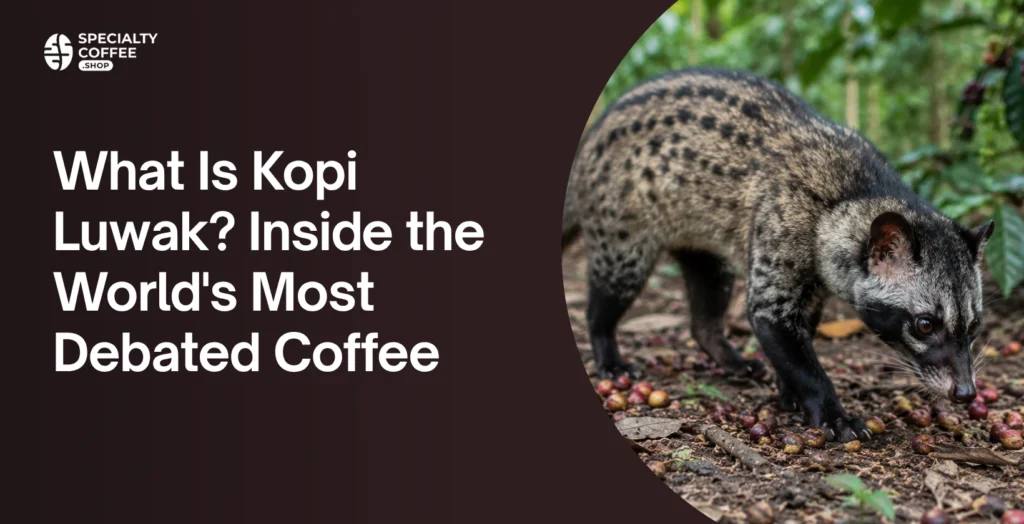
So, what is kopi luwak? It is the coffee produced when an Asian palm civet eats ripe coffee cherries, ferments them inside its gut, and passes the beans intact, which collectors then clean and roast. Moreover, it carries a reputation as the world’s rarest and priciest coffee. It also carries the industry’s hardest ethical questions, because much of it comes from caged animals. This guide covers the animal, the process, the price, the welfare debate, and how to judge a genuine cup.
The short answer to what is kopi luwak: it is a coffee made from arabica cherries that an Asian palm civet eats, partially ferments inside its digestive tract, and excretes, after which collectors gather, clean, dry, and roast the beans. It is a processing method, not a bean variety.
What Is Kopi Luwak, Exactly?
Kopi luwak is a coffee defined by its processing route, not by a plant. The term combines two Indonesian words, “kopi” (coffee) and “luwak” (the civet). The animal responsible is the Asian palm civet, Paradoxurus hermaphroditus, a small nocturnal mammal native to Southeast Asia.
When people ask what is kopi luwak, they often expect a bean variety like Geisha or Bourbon. It is instead a fermentation method applied to ordinary arabica cherries. Since it is a method rather than a bean, the same origin can be sold as washed coffee or as civet coffee, with only the processing changed. Because it is a process rather than a cultivar, kopi luwak sits outside the botanical categories mapped in this guide to coffee varieties, which sort coffees by plant genetics instead of by how the bean is fermented.
How Does the Civet Turn Cherries Into Coffee?
Understanding what is kopi luwak starts with the civet’s digestion, because that digestion is the entire mechanism behind the coffee. Enzymes and gastric acids in the civet’s tract break down proteins in the bean, which lowers bitterness and shifts the aroma, a chemistry documented by food scientist Massimo Marcone. The beans are not digested away. They pass through whole and fermented.
Production is slow and low-yield. Producing one kilogram of finished wild kopi luwak requires collecting roughly 5 to 10 kilograms of raw civet droppings, depending on terrain and cherry season (industry production data, 2026). After collection, the beans are washed, sun-dried, hulled, and roasted at high temperature, near 200 degrees C, to ensure safety and develop flavor.
This natural fermentation differs from human-controlled methods. Producers of anaerobic coffee ferment cherries in sealed, oxygen-free tanks under monitored conditions, while kopi luwak fermentation happens uncontrolled inside a living animal. The comparison shows why civet coffee is hard to standardize from batch to batch.
Wild-Sourced vs. Caged Kopi Luwak
Anyone asking what is kopi luwak eventually reaches the sourcing question, because wild and caged production look identical in the bag but differ completely in ethics and quality. Wild collection gathers droppings from free-roaming civets along forest edges. Caged production confines animals in wire cages, roughly one square meter each, and force-feeds them cherries.
The welfare record is well documented. PETA’s investigations into civet coffee farms in 2020 and 2024 found sick Asian palm civets in barren cages, and the group reports that producers routinely mislabel caged coffee as “wild-sourced” (PETA, cited 2025). World Animal Protection’s civet coffee campaign inspected 26 venues across Bali, Lombok, and Gili Trawangan and found none met the animals’ basic needs (welfare investigations, cited 2025).
The scale explains the mislabeling. PETA reports jungle collection yields no more than about 20 kilograms of civet faeces per year, while caged, force-fed civets can produce up to 400 kilograms per year (PETA, cited 2025). Welfare groups estimate up to 80 percent of coffee sold as “wild” civet coffee comes from caged animals (welfare investigations, cited 2025). The Asian palm civet is a CITES-protected species, which adds a legal dimension to sourcing.
| Attribute | Wild-sourced kopi luwak | Caged kopi luwak |
|---|---|---|
| Civet condition | Free-roaming, varied natural diet | Confined in ~1 m2 wire cages, force-fed |
| Cherry selection | Civet picks peak-ripe cherries | Fed available cherries regardless of ripeness |
| Annual yield per collector | Up to ~20 kg faeces/year (PETA, 2025) | Up to ~400 kg faeces/year (PETA, 2025) |
| Typical retail price | ~USD 600 to 1,300/kg (2025) | ~USD 100/kg (2025) |
| Welfare status | No caging, forest-edge collection | Documented as inhumane by PETA and World Animal Protection |
| Share of “wild”-labeled market | Minority | Up to ~80% mislabeled as wild (2025) |
Is Kopi Luwak Actually Good Coffee?
The most common follow-up to what is kopi luwak is whether it truly tastes better, and the honest answer is that its quality remains contested, not settled. Some formal evaluations rate it as specialty grade. Others, run blind, rank it below ordinary coffees. That contradiction is the real reason it is the most debated coffee in the specialty world.
Two data points frame the debate. A cupping test using the Specialty Coffee Association method, run by food-science researcher Murna Muzaifa at Universitas Syiah Kuala, scored one kopi luwak lot at 84.50, which clears the 80-point specialty threshold (peer-reviewed cupping data, cited 2025). Yet the Specialty Coffee Association’s own blind evaluation of commercial samples found kopi luwak scored below the comparison coffees (SCA cupping, cited 2025). One likely explanation is that most commercial samples are caged product from stressed animals, where the enzymatic chemistry works differently.
This is also why what is kopi luwak cannot be judged by the civet process alone. Most authentic lots use arabica cherries, whose acidity and sweetness differ sharply from robusta, a contrast detailed in this arabica vs robusta taste comparison. Altitude sets the ceiling too, because higher-grown arabica tends to score better before any civet ever touches it.
How to Tell Real Wild Kopi Luwak From Mislabeled Coffee
The practical side of what is kopi luwak comes down to verification, because you confirm a genuine lot through traceability rather than the label on the front of the bag. Certificates alone are weak evidence, since welfare groups report they are often meaningless. The reliable signal is a documented chain from a named farm or region to the cup.
Use these checks before buying:
- Demand named-origin traceability. A credible lot names the growing region, not just the country.
- Treat “100% wild-sourced” claims skeptically. Ask what evidence supports the wild claim, since mislabeling is common.
- Compare the price to reality. Wild civet coffee near USD 100 per kilogram is a warning sign, because that is roughly the farmed price (industry price data, 2025).
- Prefer sellers who publish sourcing details. Transparency about the supply chain is harder to fake than a logo.
- Consider whether you need civet processing at all. A traceable washed single-origin often delivers a cleaner cup for less.
Traceability is exactly where the single-origin model contrasts with novelty civet coffee. A curated single-origin lot such as Uganda Bugisu from the Mount Elgon region is traceable to a named growing area, which is the transparency most kopi luwak marketing cannot offer. The wider history of coffee’s global spread, including how novelty coffees gain fame, is well covered by Smithsonian Magazine’s reporting on coffee history.
Frequently Asked Questions
What is kopi luwak made from?
Kopi luwak is made from ordinary arabica coffee cherries that an Asian palm civet eats and excretes. The civet ferments the beans inside its digestive tract, which alters their chemistry. Collectors then wash, dry, and roast the beans. The animal supplies the fermentation, so it is a process, not a plant.
Why is kopi luwak so expensive?
Kopi luwak is expensive because genuine wild supply is tiny and labor-intensive. Producing one kilogram takes 5 to 10 kilograms of collected droppings, all gathered by hand. Authentic wild lots ran roughly USD 600 to 1,300 per kilogram in 2025, versus about USD 100 per kilogram for farmed beans (industry price data, 2025).
Is kopi luwak ethical to drink?
Only when it is verified wild-sourced. Caged production, which welfare groups estimate makes up as much as 80 percent of the market (welfare investigations, 2025), confines and force-feeds civets in tiny cages. Genuinely wild, traceable collection from free-roaming animals avoids that harm, which is why sourcing evidence matters more than any label.
Does kopi luwak taste better than regular coffee?
Not reliably. One SCA-method study scored a kopi luwak lot at 84.50, within specialty grade, while the SCA’s own blind test ranked kopi luwak below the comparison coffees (cupping data, 2025). Digestion lowers bitterness and can add smoothness, but stressed caged animals produce inconsistent results, so quality depends heavily on sourcing.
How can you verify wild-sourced kopi luwak?
Verify it through documented traceability, not certificates. Look for a named farm or region, published sourcing details, and a price consistent with genuine scarcity. Be skeptical of any “100% wild” claim without evidence, since mislabeling is widespread. Understanding what is kopi luwak sourcing is the single best defense against paying a premium for caged coffee.
Which coffee is a good alternative to kopi luwak?
A traceable single-origin arabica is the most practical alternative. It delivers a clean, well-documented cup without the welfare risk that shadows caged civet coffee. Washed lots from named regions, evaluated by cupping score, offer transparency that novelty coffee rarely matches, and they usually cost far less than authentic wild kopi luwak.
The Bottom Line
Understanding what is kopi luwak means holding two truths at once: the civet process is real, yet most market supply raises serious welfare and honesty concerns. The deciding factor is never the label but the sourcing. Curated single-origin coffee, quality-verified and traceable to a named region, answers the transparency question that novelty coffee leaves open.
If verifiable sourcing matters to you, explore further at the SpecialtyCoffee.Shop homepage, where curated single-origin lots from major producing countries are selected for quality and traceability. Browse the range, from bright Kenya AA to balanced Colombia Huila, and learn how named-origin coffee makes transparency a standard you can verify for yourself rather than merely trust.


