
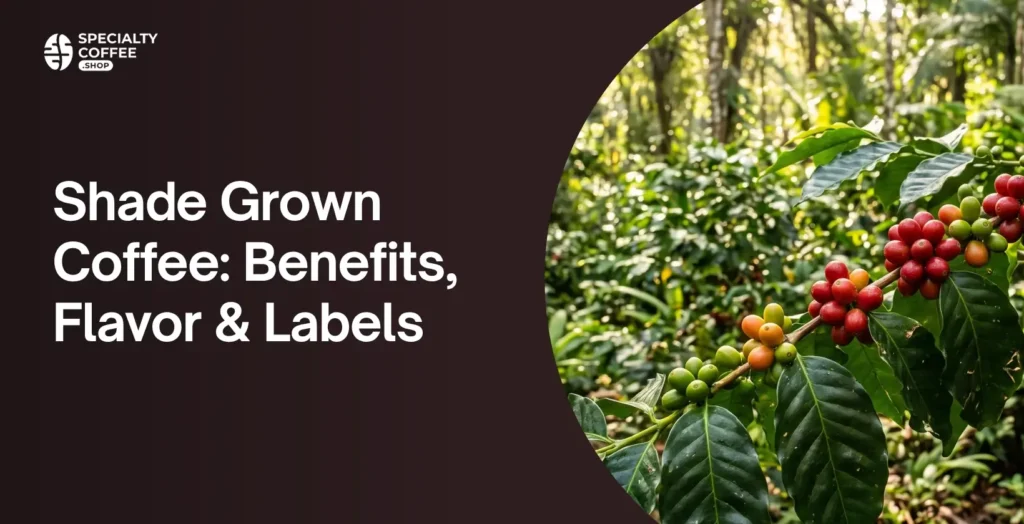
Shade grown coffee is coffee cultivated beneath a canopy of trees rather than in a simplified full-sun system. The approach can support biodiversity, moderate farm microclimates, protect soil, and provide farmers with additional products from the same land. However, the phrase itself does not describe one universal farming standard.
That distinction matters when choosing coffee. Two bags labeled shade grown coffee can come from farms with very different tree diversity, canopy density, and management practices.
- Shade can help moderate temperature extremes and improve soil moisture retention.
- Diverse, multi-layered tree canopies generally provide better wildlife habitat than simplified shade systems.
- Shade-grown coffee does not automatically mean the coffee is organic, Fairtrade, or Bird Friendly certified.
- Flavor is influenced by factors such as variety, altitude, processing, harvest quality, storage, roasting, and shade—not by shade alone.
- Transparent farm information and credible third-party certifications provide stronger evidence than a front-label sustainability claim.
What Does Shade Grown Coffee Actually Mean?
In practical terms, shade grown coffee comes from coffee plants cultivated beneath other vegetation. Those plants may include native forest trees, fruit trees, timber species, nitrogen-fixing trees, or a mixture of several types.
This creates a form of coffee agroforestry rather than a coffee-only field.
The important detail is canopy quality.
A 2024 meta-analysis found significantly greater species diversity in high-shade coffee farms than in full-sun systems. A newer global analysis published in 2025 adds an important caveat: the greatest biodiversity advantages were associated with diverse agroforestry containing native trees, while simplified shade systems did not necessarily perform much better than monocultures.
So, instead of asking only, “Is this coffee shade grown?” a more useful question is:
“What kind of shade system does the farm maintain?”
Why Shade Matters for Coffee Farms
A well-managed tree canopy changes the environment surrounding coffee plants.
Shade trees can reduce extreme temperature fluctuations, intercept rainfall, provide leaf litter, improve water infiltration, and help protect sloping soils from erosion. Smithsonian research also associates well-developed shaded coffee systems with bird habitat, pollination, biological pest control, soil protection, and carbon storage.
Trees may also produce fruit, timber, firewood, spices, or other marketable products.
That makes shade grown coffee part of a larger farm ecosystem rather than simply an environmental phrase printed on a coffee bag.
Does Shade Grown Coffee Taste Better?
Sometimes, but there is no universal “shade-grown flavor.”
Under suitable conditions, a cooler shaded microclimate can influence how coffee cherries develop. But cup quality is also shaped by genetics, altitude, soil, cherry maturity, fermentation, processing, drying, storage, and roast development.
A shade grown Arabica coffee from a high-elevation washed lot, for example, may taste floral, citrusy, and clean. A shaded wet-hulled Indonesian coffee can instead show a heavier body with herbal, spice, cocoa, or earthy characteristics.
Shade is one layer of the flavor story, not a guarantee.
Processing can often explain sensory differences more directly. See the SCS guide to coffee processing methods for a closer look at washed, natural, honey, and wet-hulled coffees.
Shade Grown vs. Bird Friendly, Organic, and Fairtrade
These terms can overlap, but they do not mean the same thing.
- Shade grown coffee describes a cultivation approach. Without additional documentation, however, the claim may not tell you the percentage of canopy cover, number of tree species, or whether the farm has been independently inspected.
- Bird Friendly coffee is more specific. Under the Smithsonian Bird Friendly agroforestry pathway, certified coffee farms must maintain an average of 40% shade, at least 10 tree species per hectare, and a majority of native trees. Bird Friendly farms must also satisfy organic requirements.
Learn more through the Smithsonian Bird Friendly certification program.
- Organic coffee refers primarily to how the crop is produced and which inputs are permitted. Organic and shade-grown therefore describe different attributes of a farm.
- Fairtrade coffee focuses strongly on economic, social, supply-chain, and environmental standards for producers. A fair trade shade grown coffee can combine both values, but a Fairtrade label should not be interpreted as documentation of a particular canopy structure in the same way as a shade-specific standard.

How to Evaluate Shade Grown Coffee Before You Buy
Do not rely on the front label alone. Use a short evidence checklist.
- Look for traceability: Check whether the seller identifies the country, region, farm, estate, cooperative, or producer.
- Look for canopy information: Native tree diversity, several vegetation layers, and measurable shade coverage provide more useful evidence than simply saying “grown under trees.”
- Verify certifications: When Bird Friendly, organic, or Fairtrade claims appear, check for the relevant certification or program.
- Check processing: Washed, natural, honey, and wet-hulled processing may explain flavor differences more clearly than shade claims alone.
- Check lot information: Harvest condition, storage, moisture stability, defects, and green-coffee quality still matter.
- Sample the coffee when possible: For professional sourcing, sample roasting and side-by-side cupping remain practical ways to determine whether a lot actually fits the intended roast or menu.
Shade Grown Coffee and Biodiversity: The Important Caveat
The strongest ecological case is for diverse agroforestry, not simply any amount of shade.
The 2024 meta-analysis comparing shade intensities found greater species diversity under high-shade conditions, particularly for wildlife groups such as birds, insects, mammals, and epiphytes.
However, the 2025 global comparison found that diverse agroforestry systems containing native tree species had significantly lower species loss than monocultures, while more intensive agroforestry systems could perform much more like monocultures.
This prevents a common mistake: assuming every shade grown coffee delivers identical environmental benefits.
Canopy percentage matters, but so do:
- tree diversity
- native species
- canopy layers
- surrounding habitat
- farm-management intensity
- landscape connectivity
For farm planning, the World Coffee Research Shade Catalog provides information on tree species that can support coffee, household income, wildlife, and ecosystem services.
Shade Grown Coffee vs. Sun Grown Coffee
Neither system can be judged solely by one variable.
Full-sun systems may offer higher coffee yields in some circumstances, while shaded systems can provide stronger ecosystem services. Smithsonian’s review specifically notes this yield-versus-sustainability trade-off.
Shade also needs active management.
Too much competition for light, water, or nutrients can reduce coffee performance if tree species and canopy density are poorly matched to local conditions.
Rainfall, altitude, cloud cover, wind, coffee variety, disease pressure, slope, and farm economics therefore influence the ideal shade level.
That is why shade grown Arabica coffee should be viewed as an agroforestry design decision, not a rule that more shade is always better.
Where Shade Grown Coffee Fits in Specialty Coffee
Within specialty coffee, shade should be evaluated alongside cup quality, traceability, processing, variety, harvest condition, and producer practices.
SCS already documents how origin and processing influence Indonesian coffees, including agroforestry and wet-hulled production. Readers exploring that context can continue with the guide to types of Indonesian specialty coffee or the deeper discussion of Sumatra coffee and processing.
If you want to move from theory to actual origins and lots, browse the SCS specialty coffee shop and compare origin, process, flavor profile, and traceability together.
The best buying mindset is simple:
Choose shade grown coffee when both the farming evidence and the cup make sense, not because the phrase alone promises superior flavor or sustainability.
Understanding growing conditions makes it easier to evaluate coffee beyond a marketing label.
Compare different origins, processing styles, and flavor profiles to see how farm conditions translate into the cup.
Explore specialty coffee from global origins at SCS or browse the SCS Shop when you are ready to compare available coffees.
FAQ
What is shade grown coffee?
Shade grown coffee is coffee cultivated beneath a tree canopy instead of in an open, full-sun monoculture. The complexity of that canopy can vary considerably between farms.
Is all Arabica coffee shade grown?
No. Arabica can be grown under shade, partial shade, or relatively open conditions depending on climate, variety, farm design, and management goals.
Does shade grown coffee taste better?
Not automatically. Shade may influence cherry development and microclimate, but processing, variety, altitude, harvest quality, roasting, and storage also strongly influence flavor.
Is organic coffee always shade grown?
No. Organic and shade grown describe different characteristics. Organic certification concerns production practices and permitted inputs; it does not by itself describe a specific multilayer shade canopy.
Is fair trade shade grown coffee the same as Bird Friendly coffee?
No. Fairtrade and Bird Friendly address different areas. Fairtrade emphasizes producer and supply-chain standards, while Smithsonian Bird Friendly has explicit habitat, shade, tree-diversity, and organic requirements.


