
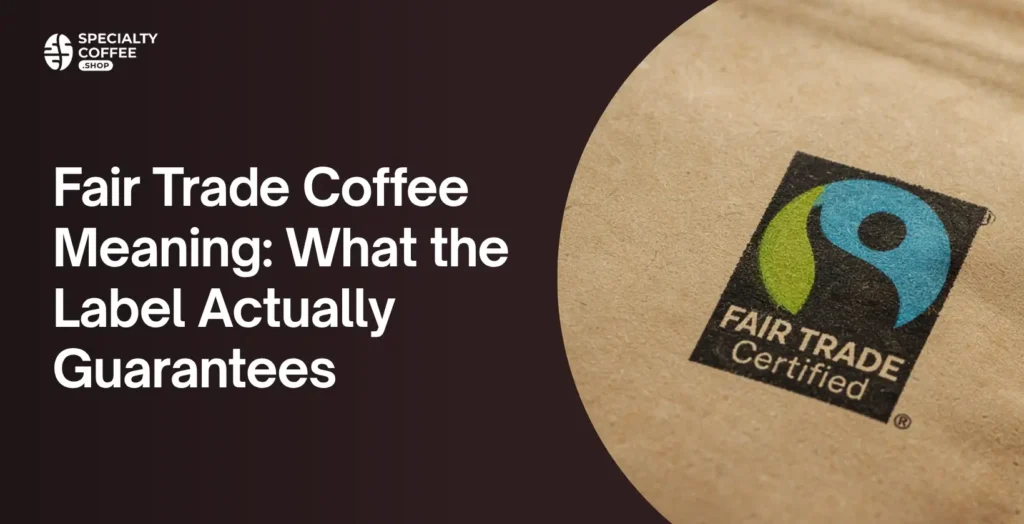
The fair trade coffee meaning is straightforward: a recognized certification label shows that the coffee was produced and traded under audited social, economic, and environmental standards. Depending on the certification system, those standards may include a minimum-price mechanism, an additional community or producer premium, labor protections, environmental requirements, and supply-chain controls.
It matters because phrases such as “ethical,” “responsibly sourced,” or even lowercase “fair trade” may be marketing language unless a named certification and verifiable seal sit behind them.
- The label covers trade conditions and production standards, not flavor quality.
- Fair trade coffee is not automatically organic.
- Certified supply chains are audited, but certification does not erase every risk.
- The exact guarantee depends on the organization named on the package.
Fair Trade Coffee Meaning in One Sentence
The fair trade coffee meaning is that an independent certification program has checked whether participants in the coffee supply chain follow its published rules. Fairtrade International uses the FAIRTRADE Mark and relies on independent certification through FLOCERT. Fair Trade USA operates the Fair Trade Certified label under its own standards.
“Fair trade” describes a broad movement, while “Fairtrade” and “Fair Trade Certified” identify specific systems. Look for the certifier’s name rather than assuming every ethical-sourcing claim offers the same protection.
Why the Fair Trade Coffee Meaning Matters on the Label
The fair trade coffee matters because a visible seal can be checked against published rules, while broad ethical language may have no shared benchmark.
For single-ingredient products such as coffee, the standard FAIRTRADE Mark indicates that the product meets Fairtrade requirements and is physically traceable through the supply chain. Other certification programs may use different standards, labels, and assurance models.
What Does a Fair Trade Coffee Label Guarantee?
A credible fair trade coffee certification guarantees a defined compliance framework, not a vague promise.
Under Fairtrade International, the system includes:
- A Fairtrade Minimum Price that functions as a floor when the applicable market price falls below it
- A Fairtrade Premium paid in addition to the selling price, with producer organizations deciding how to invest it
- Social, economic, and environmental standards
- Independent audits covering farms, facilities, records, financial documents, and worker interviews
- Traceability requirements for single-ingredient products such as coffee
Fairtrade standards are independently audited by FLOCERT, an ISO 17065-accredited certification body. The Fairtrade Premium is separate from the selling price and may be invested in production, cooperative operations, or community priorities.
Fair Trade USA also applies standards addressing livelihoods, working conditions, environmental protection, community development funds, and supply-chain transparency. Mechanisms differ, so the logo is only the starting point. The certifier’s standard is the real promise.
What the Label Does Not Guarantee
Understanding the fair trade coffee meaning also requires knowing its limits.
The label does not automatically guarantee:
- Specialty-grade quality. Certification evaluates production and trading conditions. It does not promise a particular flavor, sensory profile, or market value.
- A living income for every farmer. A price floor and premium may improve resilience, but income also depends on production costs, yield, farm size, market access, and certified sales volume.
- Direct trade. Certified beans may pass through cooperatives, exporters, importers, and roasters.
- Organic production. Fair trade and organic certification evaluate different attributes.
- A perfect supply chain. Audits create controls and accountability, but no assurance system can eliminate every risk.
Specialty coffee is recognized through distinctive intrinsic and informational attributes, including flavor, aroma, origin, production, and processing information. These attributes are evaluated separately from fair trade certification.
Read the label precisely. It verifies a standard and control process, not every desirable outcome.
Is Fair Trade Coffee Organic?
No. The fair trade coffee organic combination requires two distinct claims unless a specific program clearly states otherwise. Fair trade certification primarily addresses trading terms, producer organization, labor protections, community benefits, and environmental practices. Organic certification verifies compliance with a separate agricultural production and handling standard.
The fair trade coffee meaning should therefore be read separately from organic status. In the United States, coffee represented as USDA Organic must be certified through a USDA-accredited certifying agent, subject to limited exemptions. A bag may carry both a fair trade seal and the USDA Organic seal, only one of them, or neither.
On the shelf, find the named fair trade logo, check separately for an organic seal, then read the origin, process, roast date, and tasting notes. Each claim supports a different attribute.
How Fair Trade in Coffee Works in Practice
Consider a smallholder cooperative selling washed Arabica. When the market price is above the Fairtrade Minimum Price, the market or negotiated contract price applies.
When the market falls below the floor, the minimum-price mechanism becomes relevant. The buyer also pays the applicable Fairtrade Premium, which the cooperative allocates through its governance process.
That structure shows why fair trade in coffee is more than a retail slogan. It creates rules around price protection, additional funds, participation, and documented transactions.
Retail price still reflects quality, logistics, roasting, packaging, and margin. It does not reveal producer payments unless the seller publishes more sourcing data.
How to Evaluate a Fair Trade Coffee Before Buying
Use this five-point check:
- Identify the seal. Confirm whether it is FAIRTRADE, Fair Trade Certified, or another recognized program.
- Verify the standard. Review the certifier’s price, premium, labor, environmental, and traceability requirements.
- Separate ethics from quality. Check variety, elevation, process, roast profile, and freshness.
- Look for sourcing detail. Cooperative names, regions, harvest information, and documented origins add useful context.
- Avoid unsupported language. “Ethical” and “farmer friendly” are not substitutes for verifiable evidence.
Fair Trade vs. Direct Trade vs. Organic Coffee
These terms answer different questions. The fair trade coffee meaning concerns verified trade and production rules, while the other claims describe different relationships, farming systems, or quality attributes.
| Claim | Main question answered |
|---|---|
| Fair trade certification | Were defined social, economic, environmental, and trading standards followed? |
| Direct trade | Did the buyer build a more direct sourcing relationship? The term has no single universal certification standard. |
| Organic certification | Were regulated organic production and handling requirements followed? |
| Specialty coffee | Does the coffee possess distinctive sensory, physical, origin, or processing attributes? |
A coffee can fit more than one category. A distinctive lot may be fair trade and organic. Another may involve direct sourcing but carry no certification. The stronger decision comes from combining evidence rather than treating one label as a complete verdict.
Conclusion
The fair trade coffee meaning is not “this coffee solved every problem in the supply chain.” It means a named program has set standards, required documentation, and created an auditing or assurance process around how the coffee was produced and traded.
Use the label as a meaningful filter, then look deeper at origin, freshness, sensory attributes, and sourcing transparency.
Ethical labels are most useful when they are considered alongside origin, processing, freshness, and cup characteristics.
Reviewing these details together makes it easier to choose coffee based on evidence rather than packaging language alone.
Explore the selected coffee collection from SCS and compare the available origins and product attributes.
FAQ
What does fair trade mean on a coffee bag?
It means the coffee is connected to a certification program with defined social, economic, environmental, and trading requirements. Check the exact logo because different certifiers use different standards.
Does fair trade coffee mean farmers receive the retail price?
No. The retail price also covers export, transport, importing, roasting, packaging, distribution, and seller costs. Certification governs specified producer payments and trading conditions, not the allocation of the entire retail price.
Is fair trade coffee always organic?
No. Fair trade and organic are separate certifications. A coffee carrying both claims should display evidence of each.
Is fair trade coffee higher quality?
Not automatically. Certification does not promise a certain sensory score, roast quality, freshness level, or flavor profile.
Is direct trade better than fair trade?
Neither term is universally better. Fair trade offers published standards and third-party assurance. Direct trade may provide closer relationships and more detailed communication, but its meaning depends heavily on the buyer’s practices.


