
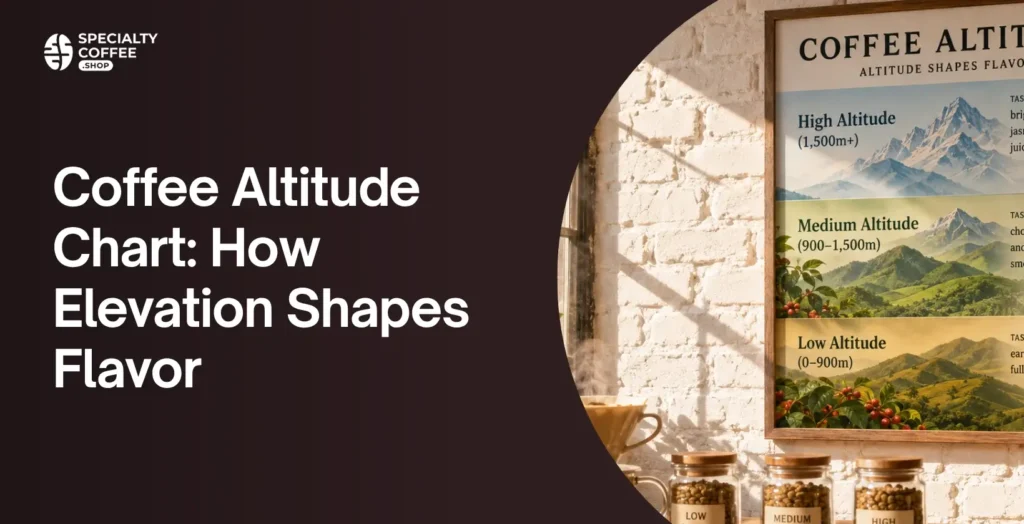
A coffee altitude chart is a useful shortcut for predicting how elevation may influence flavor. Lower-grown coffees often lean toward rounder, softer acidity, while higher-grown coffees frequently show brighter acidity, stronger aromatics, and greater complexity.
The reason is not altitude alone. Higher elevations are generally cooler, which can slow cherry maturation and influence the development of compounds that eventually shape the cup.
Research reviews have found a consistent association between increased altitude and improved sensory attributes, although latitude, coffee variety, shade, processing, and farm conditions can change the outcome.
- Below about 900 MASL: Often produces rounder, softer, and lower-acid flavor profiles.
- 900–1,200 MASL: Commonly associated with balanced cups featuring sweet, nutty, or chocolate-forward notes.
- 1,200–1,500 MASL: Often delivers brighter acidity, fruitier flavors, and more pronounced aromatics.
- 1,500–1,800+ MASL: Offers greater potential for floral, citrus, berry characteristics, and structured acidity.
- Altitude is a clue, not a quality grade: Cup quality ultimately depends on factors such as variety, climate, farming, processing, roasting, and brewing—not elevation alone.
Coffee Altitude Chart: A Practical Flavor Guide
Use this coffee altitude chart as a tasting map rather than a promise. It is especially useful for Arabica grown within tropical coffee-producing regions.
Coffee Altitude Infographic
| Elevation | Growing Environment | Typical Flavor Direction | Common Sensory Associations |
|---|---|---|---|
| Below 900 MASL / 2,950 ft | Warmer, faster maturation | Softer acidity, simpler structure | Cocoa, nuts, earth, soft fruit |
| 900–1,200 MASL / 2,950–3,940 ft | Moderate temperatures | Balanced sweetness and acidity | Caramel, chocolate, nuts, mild fruit |
| 1,200–1,500 MASL / 3,940–4,920 ft | Cooler, slower maturation | Brighter and more aromatic | Citrus, stone fruit, red fruit |
| 1,500–1,800 MASL / 4,920–5,900 ft | Cool, prolonged development | Structured acidity and complexity | Florals, berries, citrus, tea-like notes |
| Above 1,800 MASL / 5,900 ft | Very cool, long maturation | Potentially high clarity and complexity | Delicate florals, vivid fruit, refined acidity |
There is one important complication: latitude.
World Coffee Research notes that optimal growing altitude varies with a farm’s latitude. Coffee cultivated close to the equator may require significantly greater elevation to reach climatic conditions comparable with farms farther north or south.
That means a coffee at 1,100 MASL in Brazil should not automatically be judged against a coffee grown at 1,100 MASL in equatorial East Africa.

Why Higher Elevation Often Changes Coffee Flavor
Higher elevation usually brings lower average temperatures. Cooler conditions can lengthen fruit development, allowing coffee cherries to mature more gradually before harvest.
A systematic review examining environmental and management effects on coffee quality identified increased altitude as one of the most consistent factors associated with improved sensory characteristics. The same review also found that light exposure and shade matter, which shows why elevation cannot be separated from the surrounding microclimate.
A field study involving Arabica coffee in Brazil reached a similarly nuanced conclusion. Coffee quality varied with both altitude and solar exposure, demonstrating that the effect of elevation depends in part on the conditions the plant experiences at that elevation.
This is where the coffee altitude chart becomes useful. It converts a complex environmental variable into a likely sensory direction without pretending to predict an exact tasting note.
Bean density is often discussed alongside high-altitude coffee as well. Slower development can contribute to harder green beans under certain growing conditions, an attribute that matters during roasting.
Genetics, moisture content, bean structure, and environmental conditions also affect density, however, so altitude should never be treated as a density measurement by itself.
Does Higher Altitude Always Mean Better Coffee?
No. Higher altitude does not automatically produce better coffee.
A 1,900-meter coffee harvested unripe, processed carelessly, or stored poorly may taste worse than a meticulously produced coffee from 1,100 meters. Variety matters too. World Coffee Research defines suitable altitude in relation to both genotype and latitude, making a universal “best coffee altitude” scientifically misleading.
The coffee altitude chart works better as a screening tool. When comparing bags, evaluate elevation alongside:
- origin and region
- coffee variety
- processing method
- roast level
- tasting notes
- traceability and freshness
Together, those details reveal far more than altitude alone.
How to Use a Coffee Altitude Chart When Buying Beans
Start with the flavors you enjoy, then use the coffee altitude chart to narrow your choices.
For chocolate, caramel, nuts, fuller body, and restrained acidity, explore coffees within the lower and middle bands first. Some Brazilian and Indonesian coffees naturally fit this direction, although variety, processing, and roast can shift the profile considerably.
For jasmine, citrus, berries, stone fruit, or crisp acidity, higher-grown coffees are worth exploring. Ethiopia, Kenya, Colombia, Rwanda, and other mountainous origins frequently produce coffees within these elevation bands.
A practical tasting exercise makes the difference easier to understand. Brew two washed Arabicas at similar roast levels but noticeably different growing elevations. Keep your grinder, water, dose, temperature, and brewing recipe constant.
Taste both as they cool.
Differences in aroma, acidity structure, sweetness, and finish will often become easier to recognize than when the coffees are tasted several days apart.
For a broader buying framework, the SCS guide to how to choose coffee beans explains how elevation fits alongside freshness, origin, roast, and flavor preference.
Altitude vs. Origin vs. Processing
None of these variables works independently.
Altitude influences the growing environment. Origin adds regional climate, soil, and geography. Variety provides genetic potential. Processing then changes how harvested cherries become green coffee.
A washed high-altitude coffee, for example, may emphasize clean acidity and citrus-like clarity. A natural coffee from a similar environment can shift toward berry sweetness, heavier fruit, and fermentation-driven character.
Roasting adds another filter.
This is why the coffee altitude chart belongs within the broader concept of coffee terroir. Elevation is one coordinate on the map, not the entire map.
Conclusion
A coffee altitude chart helps predict flavor direction rather than determine quality. Higher elevations often coincide with cooler conditions, slower maturation, brighter acidity, and greater aromatic complexity, while lower elevations can produce rounder, softer profiles.
The relationship is useful, but never absolute. Latitude, variety, microclimate, processing, roast, and farming practices can all reshape what eventually reaches the cup.
Use altitude as one part of the buying decision. Then compare it with origin, process, variety, and tasting notes to find coffees that actually match the flavors you enjoy.
If the coffee altitude chart has helped narrow the flavor profile you want, the next step is comparing those expectations with real, traceable coffees.
SCS brings together specialty coffees from multiple origins, making it easier to compare elevation, origin, process, roast, and cup character rather than selecting beans from altitude alone.
Explore the specialty coffee selection at SCS and compare coffees by the characteristics that matter most in your cup.
FAQ
What altitude is best for coffee?
There is no universal best elevation. For Arabica near the equator, many quality-focused farms operate above roughly 1,200 MASL, but optimal altitude changes with latitude, variety, temperature, and local growing conditions. World Coffee Research explicitly incorporates latitude when defining suitable elevation ranges.
Does high-altitude coffee taste better?
Not automatically. Research generally associates greater elevation with stronger sensory quality, but poor harvesting, processing, storage, or roasting can erase that advantage.
What does MASL mean on coffee bags?
MASL means meters above sea level. A label showing 1,600 MASL indicates that the coffee was grown approximately 1,600 meters above sea level.
Why does high-altitude coffee often taste more acidic?
Higher elevations frequently create cooler growing conditions and slower cherry development. These conditions can contribute to brighter, more structured sensory characteristics, although perceived acidity also depends on variety, processing, roast, and extraction.
Is 1,200 MASL considered high-altitude coffee?
It can be, depending on the country and latitude. A fixed global threshold is misleading because similar temperatures can occur at different elevations in different coffee-producing regions.


