A coffee cherry is the small, fleshy fruit of the coffee plant, and the bean you grind every morning is the seed inside it. Its ripeness, harvest method, and processing shape the flavor in your cup long before roasting begins.
For anyone moving from supermarket coffee into specialty coffee, the fruit is where quality is first won or lost. Decisions made at origin, from how ripe each coffee cherry is when picked to how quickly its pulp is removed and how slowly the seed dries, leave traces a cupper can taste, whether the lot comes from Aceh Gayo, Ethiopia, or Colombia. Understanding the fruit is the first step to reading a bag label with confidence.
What Is a Coffee Cherry?
A coffee cherry is the drupe, or stone fruit, produced by shrubs in the genus Coffea, most commonly Coffea arabica and Coffea canephora (robusta). Each fruit is roughly the size of a cranberry and usually holds two seeds that become coffee beans.
Coffee trees flower in clusters along the branches, and each pollinated flower develops into one coffee cherry. Flowering can stretch over weeks, so ripe and green fruit often hang side by side at harvest.
Coffea liberica, grown in parts of Indonesia, produces a larger fruit with thicker pulp, so the species is the first clue to the cup profile.
Coffee Cherry Anatomy: The Layers From Skin to Seed
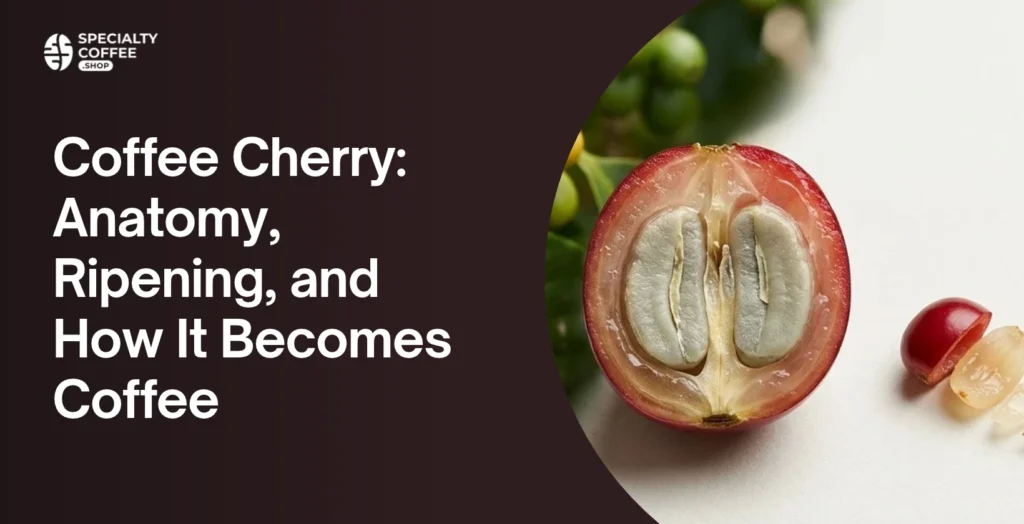
A coffee cherry has six main layers, from the outside in: outer skin, pulp, mucilage, parchment, silver skin, and the seed.
Outer Skin and Pulp
The outer skin (exocarp) is a thin, waxy layer that turns from green to red, or to yellow in varieties such as Yellow Bourbon and Yellow Catuai. Under it lies the pulp (mesocarp), a sweet, watery flesh that makes up much of the fruit’s weight but contributes no beans.
Mucilage and Parchment
Mucilage is a sticky, sugar- and pectin-rich layer that clings to the seed after the pulp is removed. Beneath it, the parchment (endocarp) forms a papery hull around each seed. Mucilage drives fermentation during processing, while parchment shields the seed as it dries and rests.
Silver Skin and the Bean
The silver skin (spermoderm) is a thin membrane wrapped directly around the seed; most comes off at hulling, and the rest flakes away as chaff during roasting. The seed (endosperm) is the green coffee bean, a dense store of carbohydrates, proteins, lipids, acids, and caffeine that roasting turns into aroma and flavor.
Peaberries and Other Variations
A peaberry is a coffee cherry that develops a single round seed instead of two flat-sided ones. Peaberries make up roughly 5–7% of arabica and robusta harvests, according to Cenicafé research on peaberry shape and size in postharvest processing, and are usually sorted out during grading so they can be roasted as a separate lot.
| Layer | Botanical name | What happens to it |
|---|---|---|
| Outer skin | Exocarp | Removed by pulping or dried with the fruit |
| Pulp | Mesocarp | Removed, dried into cascara, or composted |
| Mucilage | Pectin layer | Fermented and washed off, or dried on the seed |
| Parchment | Endocarp | Removed at hulling before export |
| Silver skin | Spermoderm | Partly hulled off, the rest becomes roasting chaff |
| Seed | Endosperm | Becomes green coffee, then roasted coffee |
How Does a Coffee Cherry Ripen and Get Harvested?
A coffee cherry typically ripens about seven to nine months after flowering for arabica, and longer for robusta. Ripeness is the biggest quality factor a farmer controls at harvest, because the seed keeps developing sugars and acids until the fruit reaches full color.
Signs of a Ripe Coffee Cherry
A ripe coffee cherry shows three signs: full, even color, slight softness when squeezed, and sweet, juicy pulp. Producers often check sugar with a refractometer, and readings vary with variety, altitude, and climate; a study of Arabica farms in West Java found ripe fruit reaching about 12–20 °Brix, while less mature fruit read closer to 9 °Brix. Underripe fruit tastes astringent and grassy in the cup, while overripe fruit pushes flavors toward fermentation.
Why Altitude and Shade Slow Ripening
Cooler temperatures at higher elevation slow how quickly each coffee cherry matures, giving the seed more time to build density and organic acids. That is why high-grown lots often taste brighter, a pattern shown in our coffee altitude chart on how elevation shapes flavor. Canopy trees have a similar effect, and our guide to shade grown coffee and what the label means covers how shade moderates the farm microclimate.
Selective Picking vs Strip Picking
There are two main harvest methods: selective picking and strip picking. Selective pickers return to the same trees several times and take only ripe fruit, the standard for specialty lots. Strip picking clears a whole branch at once, green and overripe fruit included. Many mills then float the harvest so light, damaged fruit can be skimmed off.
[add your first-hand experience/data: e.g., ripe-fruit ratio or Brix readings from cooperatives in Aceh Gayo or Toraja during the latest harvest]
How Processing Turns the Coffee Cherry Into Green Coffee
Processing removes the fruit layers from the seed and dries it to a stable moisture content, usually around 10–12%. Once a coffee cherry leaves the tree, it must be processed within hours, because the sugary fruit starts fermenting on its own.
There are four common methods, and each removes the fruit at a different stage:
- Washed (wet process): Skin and pulp are pulped off, mucilage is broken down by fermentation, and the parchment coffee is washed and dried. Expect clarity and pronounced acidity.
- Natural (dry process): The whole coffee cherry dries intact on patios or raised beds for several weeks before hulling. Expect heavier body and fruit-forward notes.
- Honey (pulped natural): Skin and pulp are removed, but some or all mucilage stays on during drying. Expect sweetness between washed and natural; our Costa Rica coffee origin guide on Tarrazú micromills and the honey process shows where the method was refined.
- Wet-hulled (giling basah): Common in Indonesia, the parchment is removed while the seed is still moist, then the bare bean finishes drying. Expect earthy, herbal, full-bodied cups with low acidity.
Wet-hulling explains why many Sumatran and Flores coffees taste so different from washed African lots of similar varieties. For a regional example, see Flores coffee beans and Bajawa’s volcanic profile.
| Method | Fruit removed before drying | Typical cup traits |
|---|---|---|
| Washed | Skin, pulp, mucilage | Clean, bright, defined acidity |
| Natural | None | Fruity, heavy body, winey |
| Honey | Skin and pulp | Sweet, rounded, medium acidity |
| Wet-hulled | Skin, pulp, mucilage, early parchment removal | Earthy, herbal, low acidity, full body |
[add your first-hand experience/data: e.g., moisture readings at hulling in Medan or cupping score differences between washed and wet-hulled lots from the same region]
What Happens to the Rest of the Fruit?
Most farms compost the leftover fruit, use it as fertilizer, or dry it as cascara. Because skin, pulp, and mucilage make up a large share of every coffee cherry by weight, how mills handle them affects both waste and farm income.
Cascara, from the Spanish word for husk, is the dried skin and pulp of the coffee cherry, steeped like tea. It tastes of dried fruit and hibiscus rather than coffee. Untreated pulp dumped in waterways can harm rivers, so responsible mills manage wastewater and compost the fruit.
How Can Coffee Cherry Knowledge Help You Buy Better Coffee?
Knowing the fruit helps you read a bag label, because process, altitude, variety, and harvest window all describe what happened to it. Those details predict the cup better than the word “premium.”
Use these five clues when choosing a bag:
- Process: Washed for clarity, natural for fruit, honey for sweetness, wet-hulled for body.
- Altitude: Higher elevation usually means slower ripening and brighter acidity.
- Variety: Bourbon, Typica, Gesha, or SL28 each shape how fruit and seed develop.
- Harvest window: Recent harvests hold aromatics better than older green coffee.
- Traceability: A named region, cooperative, or farm suggests careful picking and sorting.
Ripe-only picking is hard to prove on a supermarket label, and our guide to what traceable coffee beans mean for buyers explains which lot details are worth checking. At SCS, the cupping score and process are published for every lot, so buyers can link the cup back to the coffee cherry it came from.
Frequently Asked Questions
1. Can you eat a coffee cherry?
Yes, a ripe coffee cherry is edible, though there is little to eat because the seeds fill most of the fruit. The thin pulp tastes sweet and slightly tart, often compared to hibiscus, watermelon rind, or red currant. Fresh fruit spoils quickly, so most people outside coffee farms only taste it as dried cascara.
2. Is coffee a fruit or a bean?
Coffee is the seed of a fruit, not a true bean. The plant produces a drupe, closer botanically to cherries and plums, and the green coffee we roast is the endosperm of its seed. The word “bean” stuck because of the shape. True beans are legumes that grow in pods, which coffee never does.
3. How long does a coffee plant take to produce fruit?
A coffee plant usually takes about three to four years after planting to produce its first meaningful crop. Yields then rise over the following years, and well-pruned trees stay productive for decades. Altitude, climate, variety, and farm management all change how quickly a young tree reaches full production.
4. Does coffee fruit contain caffeine?
Yes, coffee fruit contains caffeine, but the seed holds most of it. The skin and pulp carry smaller amounts, which is why cascara tea is mildly stimulating and generally lower in caffeine than brewed coffee. Exact levels vary with species, ripeness, drying, and steeping time, so treat caffeine figures on cascara products as estimates.
5. Why are some coffee cherries yellow instead of red?
Some varieties ripen yellow or orange because of their genetics, not because they are unripe. Yellow Bourbon, Yellow Catuai, and some Pink Bourbon lines are common examples. Pickers judge ripeness in these varieties by shade, softness, and sweetness rather than redness, which makes picker training especially important on farms growing several varieties.
Conclusion: Start With the Fruit
Every flavor in a specialty coffee starts as a decision about the coffee cherry: when it was picked, how it was sorted, and how its fruit was removed. On your next bag, read the process, altitude, and region, then taste whether the cup matches what those details predict. To see how growing regions shape fruit and flavor differently, explore the specialty coffee origins we source from around the world.