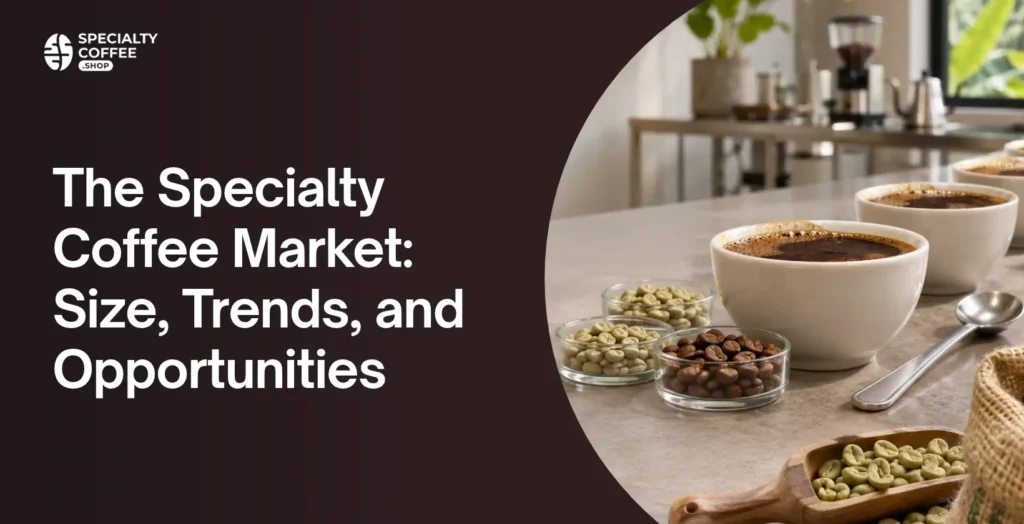
The specialty coffee market is the segment of the global coffee trade built on green coffee scoring 80 points or higher on a 100-point cupping scale, and it grows faster than commodity coffee because buyers now pay for verifiable quality, traceability, and origin. For importers, roasters, and home brewers, its size, trends, and price drivers decide what to buy and at what premium.
What Is the Specialty Coffee Market?
The specialty coffee market is the trade in coffees graded 80+ points by trained cuppers and sold at premiums above the commodity price because of cup quality and traceability. The benchmark comes from the Specialty Coffee Association’s grading and cupping standards, which also require a physical inspection: a 350-gram green sample with zero primary defects and no more than five full defects.
Scores are usually assigned by licensed Q Graders, a credential run through the Coffee Quality Institute’s Q Grader certification program. That score separates the specialty coffee market from “premium” or “gourmet” coffee, which are marketing terms with no shared standard. A specialty lot carries a score, an origin, a processing method, and ideally a harvest window.
Quality is set long before cupping, starting with fruit ripeness at picking, which is why the anatomy and ripening of the coffee cherry matter to buyers. In our Medan cupping lab, an 84-point and an 88-point Aceh Gayo are both specialty, yet they are priced, roasted, and sold differently.
How Big Is the Specialty Coffee Market?
The specialty coffee market is valued in the tens of billions of US dollars, but published estimates vary widely because each research firm defines “specialty” differently. Some reports place the global specialty coffee market near or above US$100 billion, with projected annual growth in the high single digits to low double digits; others report far smaller figures because they count only green coffee.
Specialty is still a minority of physical volume. The International Coffee Organization’s world coffee production statistics put total output at roughly 170–180 million 60-kg bags per year, and specialty-grade lots form a small share of that volume while capturing a much larger share of value.
Why Do Market Size Estimates Differ?
Market size estimates differ because analysts measure different layers of the value chain. There are 4 common scopes in specialty coffee market reports:
| Scope | What is counted | Most useful for |
|---|---|---|
| Green coffee | 80+ lots traded FOB or landed | Importers and green buyers |
| Roasted retail | Whole-bean and ground coffee sold to consumers | Roasters and e-commerce brands |
| Foodservice | Café beverages, priced with labor and rent included | Café operators and investors |
| Ready-to-drink and capsules | Cold brew, cans, and pods marketed as specialty | Packaged-goods brands |
Before quoting any figure, check which layer it counts, whether it applies the 80-point threshold, and its base year. A number that blends latte sales with green coffee value says little about real lot prices.
What Is Driving Demand?
Demand is driven by consumers trading up from commodity coffee to scored, traceable beans, particularly in the United States. The National Coffee Association’s National Coffee Data Trends research has tracked specialty beverages taking a large and rising share of past-day coffee consumption among US adults. Four forces stand out in the US specialty coffee market:
- Better home equipment: burr grinders, pour-over drippers, and home espresso machines make origin and roast date noticeable in the cup.
- Younger drinkers: cold brew and iced espresso drinks pull new consumers into the specialty coffee market earlier.
- Transparency expectations: buyers want region, altitude, process, and score printed on the bag.
- Roast-to-order e-commerce: direct shipping delivers fresh whole bean without months of shelf time.
What Trends Are Shaping Specialty Coffee Sourcing?
Three supply-side trends are reshaping the specialty coffee market: lot-level traceability, processing experimentation, and due-diligence rules on deforestation. Each one changes what buyers ask for and what producers are paid.
Traceability and Direct Relationships
Traceability means a buyer can follow a specific lot from farm or washing station to roaster. Lot-level data used to be a premium feature; in today’s specialty coffee market it is close to a baseline expectation, and what traceable coffee beans mean for buyers now shapes contracts and labels.
Many roasters pair traceability with relationship sourcing, and the difference between direct trade and Fair Trade comes down to who sets the rules and how they are verified.
Processing Experimentation
Processing experimentation means producers ferment, dry, and sort coffee in new ways to differentiate their lots. Natural, honey, anaerobic, and yeast-inoculated coffees now appear across origins, and the specialty coffee market rewards clean, distinctive results with higher scores.
In Indonesia, where wet-hulling (giling basah) long defined the Sumatran profile, more farmers now offer fully washed and natural Arabica alongside it.
Deforestation and Due-Diligence Rules
Deforestation rules require importers to prove coffee was not grown on recently cleared land. The EU Deforestation Regulation (EUDR) requires plot-level geolocation data for coffee sold in the EU, although its application date has been postponed more than once. Because geolocation favors buyers who already know their farms, it pushes the specialty coffee market further toward traceable supply and ties into wider coffee sustainability challenges from farm to cup.
Which Origins Lead, and Where Does Indonesia Fit?
Ethiopia, Colombia, Kenya, Brazil, and Central America dominate specialty menus, while Indonesia is one of the world’s largest producers by volume whose specialty Arabica remains underrepresented relative to its potential. Since every sourcing trend ultimately plays out origin by origin, the supply map matters as much as demand.
Most Indonesian output is Robusta, while specialty Arabica comes from highlands across Sumatra, Sulawesi, Flores, and Papua. The classic wet-hulled profile is heavy-bodied, low in acidity, and herbal or earthy; washed and natural lots from the same regions often show brighter fruit and cleaner sweetness. These are the six regions we cup most often:
| Region | Province | Typical altitude | Common process | Typical cup notes |
|---|---|---|---|---|
| Aceh Gayo | Aceh | 1,200–1,600 m | Wet-hulled, washed, natural | Herbal, spice, dark chocolate |
| Lintong Mandheling | North Sumatra | 1,200–1,500 m | Wet-hulled | Earthy, cedar, syrupy body |
| Kerinci | Jambi | 1,400–1,700 m | Washed, natural, honey | Brown sugar, citrus, floral |
| Toraja | South Sulawesi | 1,400–1,800 m | Wet-hulled, washed | Spice, dark fruit, balanced acidity |
| Flores Bajawa | East Nusa Tenggara | 1,200–1,600 m | Washed, semi-washed | Chocolate, tobacco, sweet finish |
| Papua Wamena | Highland Papua | 1,500–2,000 m | Washed | Clean, nutty, mild acidity |
Altitude ranges are approximate and vary by farm. Indonesia’s position in the specialty coffee market is an opening for buyers: distinctive profiles, real scale, and improving processing skill, often at differentials below comparable East African lots.
What Challenges Do Specialty Buyers and Producers Face?
There are 4 main challenges: price volatility, climate pressure, producer economics, and label dilution. Each affects both what importers pay and what reaches the farm.
- Price volatility: Arabica futures on the ICE “C” market reached record highs above US$4 per pound in early 2025. Because many contracts are priced as differentials over “C”, a futures spike lifts specialty coffee market prices even when cup quality is unchanged.
- Climate pressure: rising temperatures and erratic rainfall threaten lower-altitude Arabica, pushing cultivation higher and raising leaf rust and borer risk.
- Producer economics: labor, fertilizer, and processing costs often rise faster than premiums, so quality gains last only when producers capture enough of the price.
- Label dilution: “specialty” printed on bags without a score, origin, or roast date erodes trust across the specialty coffee market.
The common fix is verification: published scores, documented prices, and named origins give buyers something to check rather than something to believe.
Where Are the Opportunities in Specialty Coffee?
The biggest opportunities sit with buyers who pair verified quality with underused origins and direct relationships. The challenges above reward exactly those buyers, because scored, traceable coffee is easier to price, defend, and sell.
For Importers, Roasters, and Cafés
Importers and roasters gain an edge by diversifying beyond the most expensive origins. Four practical steps work well in the current specialty coffee market:
- Request pre-shipment samples and cup them against the offer score.
- Ask for altitude, process, harvest window, and plot data with every lot.
- Benchmark distinctive origins, such as Kerinci naturals or washed Toraja, against East African lots.
- Buy smaller lots across more origins to spread climate and price risk.
Our Jakarta sourcing desk supplies green coffee samples and wholesale lots, and you can talk to our sourcing and export team about current availability.
For Home Brewers
Home brewers benefit from a specialty coffee market that now ships roasted-to-order beans directly to the door. Check 4 details on every bag: a cupping score, a named region, a processing method, and a roast date. Whole-bean coffee scored 85+ and brewed within a few weeks of roasting is the clearest step up from supermarket coffee.
What Should Buyers Do Next?
Buyers should treat “specialty” as a verifiable grade, because the specialty coffee market increasingly rewards evidence over labels. Whether you import containers or brew one cup at a time, ask for the score, origin, process, and roast or harvest date, then compare like with like.
In the specialty coffee market today, informed buyers find the most value in origins outside the usual spotlight, especially Indonesia’s highland regions.
Frequently Asked Questions
1. Is specialty coffee worth the higher price?
Yes, if the price buys verifiable quality. Specialty coffee costs more because it scores 80+ points, comes from carefully picked and sorted cherries, and is usually traceable to a region or farm. Those factors produce cleaner, sweeter cups and pay producers for extra labor. Without a score, origin, or roast date, the premium is hard to justify.
2. How is specialty coffee priced compared with commodity coffee?
Specialty coffee is priced either as a differential above the ICE “C” futures price or as a fixed price negotiated per lot. Commodity coffee usually trades close to “C” with grade adjustments. In the specialty coffee market, higher scores, rarer processing, and smaller lots command larger premiums, while fixed prices give producers stability when futures swing.
3. Can Robusta be specialty coffee?
Yes. Robusta can be graded as fine-quality coffee under the Coffee Quality Institute’s Fine Robusta standards, assessed by licensed R Graders. Most Robusta is grown for volume and blends, but carefully picked and processed lots can show chocolate, nut, and spice notes with low acidity. Indonesia, Vietnam, India, and Uganda all produce fine Robusta in limited quantities.
4. Is kopi luwak considered specialty coffee?
Not automatically. Kopi luwak is defined by beans passing through a civet’s digestive tract, not by cup score, so a lot qualifies as specialty only if it is cupped and scores 80+ points. Many caged-civet products score poorly and raise serious welfare concerns. Even for wild-collected kopi luwak, buyers should ask for a score and evidence of sourcing.
5. How long does specialty coffee stay fresh after roasting?
Whole-bean specialty coffee usually tastes best within about two to six weeks of its roast date. Beans need a few days to release carbon dioxide before brewing, then slowly lose aroma as they oxidize. Store them in an airtight, opaque container at room temperature, and grind just before brewing to keep the most flavor.