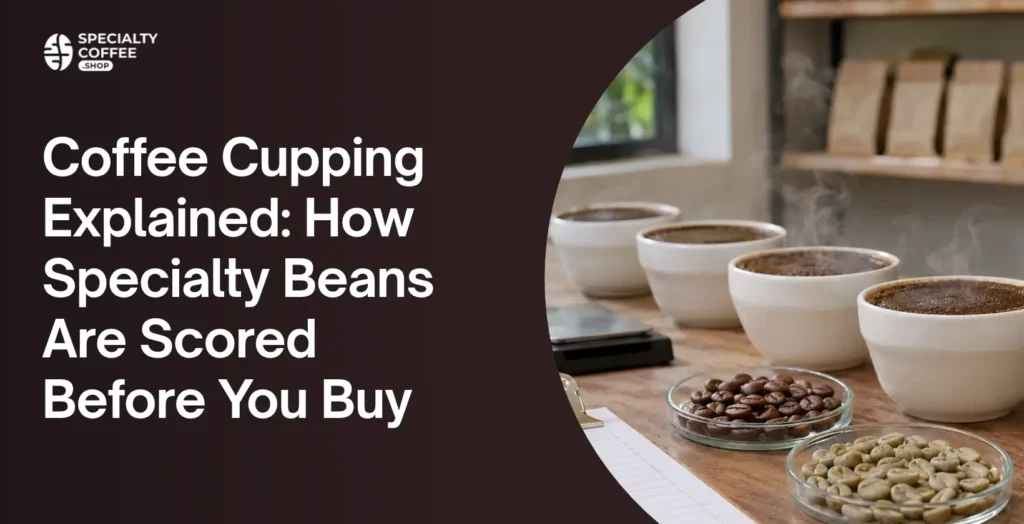
Coffee cupping is the standardized tasting method that green buyers and roasting labs use to evaluate and score a coffee before it is bought, roasted, or sold. Every lot is brewed the same way, tasted at set temperatures, and marked on a form, so the final number reflects the coffee rather than the brewer.
That number sits behind the “SCA 85+” on a specialty bag, and knowing how it is produced lets you tell a measured result from a label.
What Is Coffee Cupping?
Coffee cupping is a controlled sensory evaluation in which ground coffee is steeped directly in a bowl and tasted with a spoon to assess and score its quality. It removes recipe, filter, and barista skill, so every sample is judged under identical conditions.
Exporters, importers, and roasters use coffee cupping at three points: when an offer sample arrives, when the shipment lands, and when a roast profile is approved. Cuppers also describe flavor with shared vocabulary, much of it drawn from the World Coffee Research Sensory Lexicon, which defines 110 flavor, aroma, and texture attributes with reference standards.
So what is coffee cupping for a home brewer? It is the quality check that happened months before the bag reached you, and its output is the coffee cupping score printed on many specialty labels.
What Does a Coffee Cupping Score Measure?
A coffee cupping score is a 100-point rating that adds up marks for ten sensory attributes and subtracts points for defects. On the classic SCA form, each attribute is worth a maximum of 10 points.
The 10 attributes on the SCA form are scored in two different ways:
| Attribute | How it is scored | What the cupper checks |
|---|---|---|
| Fragrance/Aroma | Quality scale, 6.00–9.75 in 0.25 steps | Dry grounds, wet crust, and aroma at the break |
| Flavor | Quality scale | Intensity and complexity of taste and retronasal aroma |
| Aftertaste | Quality scale | Length and pleasantness of the finish |
| Acidity | Quality scale | Brightness that is lively, not sour |
| Body | Quality scale | Weight and texture in the mouth |
| Balance | Quality scale | How flavor, acidity, and body fit together |
| Overall | Quality scale | The cupper’s integrated judgment |
| Uniformity | 2 points per cup × 5 cups | Whether all five cups taste the same |
| Clean Cup | 2 points per cup × 5 cups | No negative flavors from first sip to finish |
| Sweetness | 2 points per cup × 5 cups | Pleasant sweetness in every cup |
What Do the Score Bands Mean?
Scores of 80 points and above qualify as specialty coffee. The SCA groups them into three bands: 80–84.99 is “Very Good,” 85–89.99 is “Excellent,” and 90 and above is “Outstanding.” Anything below 80 is not specialty grade, which is why the 80-point line divides commodity coffee from the premium specialty coffee trade.
How Are Defects Deducted?
In coffee cupping, defects are subtracted from the total after the ten attributes are added. A “taint” is a noticeable off-flavor that costs 2 points per affected cup, while a “fault” makes the cup unpleasant and costs 4 points per affected cup. One phenolic cup out of five can drop a coffee that tasted like an 86 below 85.
The SCA’s Coffee Value Assessment (CVA) separates physical, descriptive, affective, and extrinsic assessments instead of folding everything into one form, while many buyers still report results on the familiar 100-point scale.
How to Do a Coffee Cupping: The SCA Protocol in 7 Steps
A standard coffee cupping follows seven fixed steps, from roasting the sample to scoring as it cools. This coffee cupping how-to is an overview of what the lab does, not a brewing tutorial.
- Roast the sample. Light to medium-light, within 24 hours of the session, rested at least 8 hours.
- Weigh and grind. 8.25 g of coffee per 150 ml of water, five cups per sample, ground just before the session.
- Smell the dry fragrance. Within 15 minutes of grinding.
- Pour. Water at about 93°C (200°F), filled to the rim to saturate all grounds.
- Break the crust. At around 4 minutes, the crust is stirred and the released aroma is scored.
- Taste. Slurping starts once the coffee cools to about 71°C (160°F).
- Score. Marks are finalized as the cups near room temperature.
Current preparation details are published in the SCA coffee standards library, including SCA-102 on sample preparation and tasting mechanics. Because every variable is fixed, differences in coffee cupping results point to the green coffee, not the method.
Who Scores the Coffee? Q Graders and Calibration
Most published specialty scores are assigned by licensed Q Graders, cuppers who have passed a standardized set of sensory and grading exams.
The Q Grader license is now issued by the Specialty Coffee Association, is valid for three years, and must be renewed through continued professional development. Labs also run coffee cupping in panels and compare results against shared reference lots, because one cupper on one day can drift.
Why a Lot Passes or Fails 85+ in Our Medan Cupping Lab
A lot passes the 85+ bar only when its average panel score clears 85 with no defect deductions and all five cups tasting the same. At SCS, our Medan lab cups every sample against that rule before we commit to buying.
Coffee cupping is only half of the check. Under SCA green grading, a 350 g green sample also needs zero primary (Category 1) defects, no more than five full defects, and moisture within 9–13% to qualify as Specialty Grade. A lot can taste promising and still fail on the sorting table.
What Makes an Indonesian Lot Pass?
Indonesian lots that pass usually show three things: ripe-cherry sweetness, structured acidity rather than flatness, and a finish that stays clean as the cup cools. Many North Sumatran coffees are wet-hulled (giling basah), which builds heavy body and herbal, spice-toned flavor; our Blue Batak flavor guide shows how that profile reads in the cup. Aceh Gayo, Lintong Mandheling, and Kerinci lots that pass tend to pair that body with clarity instead of earthiness.
Why Do Lots Fail?
Most lots that miss the 85+ cut fail for one of five reasons:
- One defective cup. A single fermented or phenolic cup costs Uniformity, Clean Cup, and Sweetness points plus the defect deduction.
- Uneven drying. Inconsistently dried wet-hulled coffee can show earthy or musty taints.
- Underripe picking. Unripe cherries add astringency and cut sweetness, as explained in our guide to coffee cherry ripening and anatomy.
- Age. Past-crop coffee loses acidity and turns woody or papery.
- Flat structure. A clean but one-dimensional cup often lands at 82–84: specialty, but not 85+.
How to Read a Cupping Score on a Product Page
A cupping score on a product page is only meaningful when it comes with the context that produced it: who cupped it, when, and on which lot.
Check these five details before trusting coffee cupping results:
- The exact number. “86.25” is a measured result; “85+” or “specialty grade” alone is a range or a claim.
- Who scored it. A Q Grader or named lab panel, not an anonymous “expert.”
- The lot and harvest. A score belongs to one lot from one harvest, which is why traceable lot information matters as much as the number.
- Origin data. Region, altitude, variety, and process explain why the coffee scored as it did.
- Tasting notes. Notes should match the score; a 90-point coffee described only as “smooth” is a warning sign.
A score is one filter; roast level and brew method still decide whether you enjoy the cup, as covered in our guide to choosing coffee beans by taste, origin, and roast. Roasters, cafés, and green buyers who want their own samples scored under the same protocol can use our Q Grader sample scoring service.
Conclusion: Treat the Score as Evidence, Not a Slogan
A coffee cupping result is useful only when you can see the number, the lot, and who produced it. Next time you shop, skip bags that say “specialty” without a score and compare exact scores, harvest dates, and origin data instead. To start with lots that have already passed this check, browse our single-origin coffees with published scores.
Frequently Asked Questions
1. Is coffee cupping the same as coffee tasting?
No. Coffee cupping is a standardized form of tasting with fixed ratios, water temperature, timing, and a scoring form. Casual tasting compares coffees however they are brewed, so the brewer’s choices shape the result. Cupping removes those variables so differences come from the beans, which is why buyers rely on it.
2. Does a higher score mean I will like the coffee more?
Not necessarily. A higher score means trained cuppers found more complexity, cleanliness, and balance, but it does not predict personal taste. If you prefer heavy body and low acidity, an 85-point wet-hulled Sumatra may suit you better than a 90-point floral washed coffee. Use the score to confirm quality and the notes to choose.
3. Does roast level change a cupping score?
Yes, which is why the protocol fixes it. Samples are scored at a light to medium-light roast so origin character and defects stay visible. A darker production roast can mute acidity and add roast flavors, so the bag you buy may taste different from the cupping sample even though the green coffee is the same.
4. How long does a cupping score stay accurate?
A cupping score describes the coffee on the day it was cupped. Green coffee slowly loses acidity and aromatics as it ages, especially in warm, humid storage, so a lot that scored 86 on arrival can drift lower over the following months. Reliable sellers re-cup stored lots and update scores that no longer hold.
5. Are cupping scores used for Robusta?
Yes, but Robusta is evaluated on its own protocol with attributes adapted to the species, so a Robusta score should not be compared directly with an Arabica score. Fine Robusta from Indonesia, Uganda, and other origins is increasingly graded this way, but most published specialty scores still refer to Arabica.