Espresso beans vs coffee beans is not a contest between two plants: espresso beans are coffee beans that a roaster has roasted, blended, or labeled with espresso in mind. The differences sit in roast level, development, and origin, not in the seed.
What Are Espresso Beans?
Espresso beans are roasted coffee beans sold with a label recommending them for espresso, usually because of a darker roast and a blend built for body. “Espresso” names a brewing destination, not a botanical category. That is why espresso beans vs coffee beans confuses shoppers: two bags from one farm can carry different labels.
Where the “Espresso” Label Comes From
The label comes from the Italian tradition of dark, sweet, heavy espresso blends. The term has no regulated definition in the US. When you compare espresso beans vs coffee beans, treat the word as a recommendation and look for origin, process, roast date, and score.
Are Espresso Beans and Coffee Beans the Same Plant?
Yes, both come from the same plants: Coffea arabica (Arabica) and Coffea canephora (Robusta). Every bean is the seed of a coffee cherry, unchanged by the word “espresso.” Our guide to coffee cherry anatomy and ripening shows where the seed comes from.
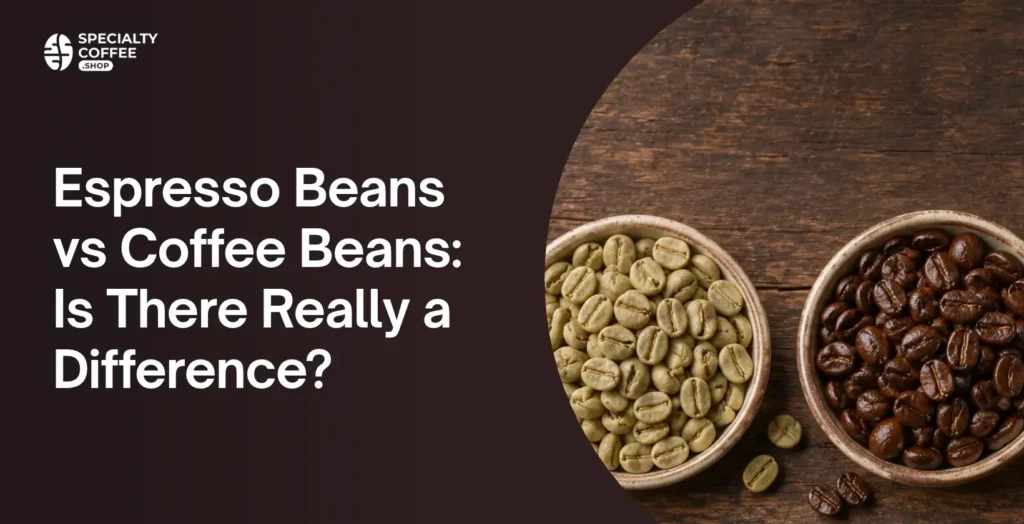
As green coffee, the two are identical; the espresso beans vs coffee beans split begins in the roastery.
Species shapes the cup, but it is not what separates espresso beans vs coffee beans. Across the Arabica and Robusta varieties grown today, Arabica brings sweetness and acidity, while Robusta brings bitterness, heavier body, and roughly twice the caffeine.
How Do Roast Level and Development Differ?
Espresso beans are usually roasted darker or developed longer than filter beans, which lowers acidity and raises body and sweetness. This is the core of espresso beans vs coffee beans. Our explainer on light, medium, and dark roast levels covers how each level tastes.
Roast Level
Traditional espresso roasts sit between medium-dark and dark, often near or into second crack at around 435°F (224°C). Filter roasts usually finish light to medium, shortly after first crack at roughly 385–400°F (196–204°C). Many specialty roasters now sell medium espresso roasts, so the gap in espresso beans vs coffee beans keeps narrowing.
Development Time
Development time is the stretch between first crack and the end of the roast, and espresso profiles usually extend it. Longer development makes beans more soluble and rounds off sharp acidity; a development time ratio near 20–25% is a common espresso rule of thumb. Two beans of identical color can taste different, a detail most espresso beans vs coffee beans guides skip.
Surface Oil and Bean Color
Oily, very dark beans signal a dark roast, not a special espresso variety. Heat pushes oils outward around second crack, so shine tells you roast depth only, never origin, freshness, or grade.
Which Origins and Blends Go Into Espresso Roasts?
Espresso roasts traditionally favor low-acid, heavy-bodied origins such as Brazil, Sumatra, and Sulawesi, often blended. Roast explains the color in the bag; origin is the least discussed side of espresso beans vs coffee beans.
Classic Espresso Blend Components
A typical espresso blend fills 3 roles:
- Base: a natural Brazil or wet-hulled Sumatra for body, chocolate, and nut.
- Sweetness: a washed Central or South American coffee for caramel and balance.
- Accent: an East African coffee for fruit, or Robusta in Italian-style blends for weight and bitterness.
What makes espresso beans different from coffee beans on the filter shelf is this blend logic, not botany. The same Brazil can fill both bags, so espresso beans vs coffee beans becomes a question of recipe, not crop.
Indonesian Origins in Espresso and Filter
Indonesian coffees suit both espresso and filter, but wet-hulled Sumatran lots are classic espresso components for their low acidity and heavy body. Wet hulling (giling basah) removes the parchment while the seed is still moist, creating an herbal, earthy cup.
Six regions we source show the range [add your first-hand experience/data]:
- Lintong Mandheling (North Sumatra): heavy body, cedar, dark chocolate; a natural espresso fit, as is Blue Batak coffee with its herbal, rounded cup from the same province.
- Aceh Gayo: washed and honey lots shine in filter; wet-hulled lots hold up in espresso.
- Kerinci (Jambi): fruit-forward natural and honey lots for lighter filter roasts.
- Toraja (South Sulawesi): full body, spice, low acidity; strong in espresso.
- Flores Bajawa: chocolate and gentle sweetness; comfortable either way.
- Papua Wamena (Baliem Valley): mild, clean, sweet; best in filter.
That is espresso beans vs coffee beans in miniature: origin sets the potential, and the roast decides the label.
Espresso Beans vs Coffee Beans: Side-by-Side Comparison
Espresso and filter bags differ in 6 roaster-controlled attributes; species stays the same. The table compares espresso beans vs coffee beans across 7 attributes of typical retail bags.
| Attribute | Typical “espresso” bag | Typical filter or whole-bean bag |
|---|---|---|
| Species | Arabica, Robusta, or a blend | Arabica, Robusta, or a blend |
| Roast level | Medium to dark | Light to medium |
| Development | Longer after first crack | Shorter, to preserve acidity |
| Origin style | Blends of low-acid, heavy-bodied origins | Often single origin, bright and aromatic |
| Typical flavor | Chocolate, caramel, nut, roast | Fruit, floral, citrus, tea-like |
| Bean surface | Matte to oily | Dry and matte |
| Label wording | “Espresso roast,” “espresso blend” | “Filter roast,” “single origin” |
Read the table as tendencies. In any coffee vs espresso beans comparison, a skilled roaster can sell a light, fruity espresso or a dark filter roast, so bag details outrank the word.
What Myths Surround Espresso Beans?
Four myths drive most confusion about espresso beans vs coffee beans: caffeine, strength, quality, and interchangeability.
Myth 1: Espresso Beans Have More Caffeine
No, the espresso label adds no caffeine. Caffeine depends mainly on species: Arabica holds about 1.2–1.5% by dry weight and Robusta about 2.2–2.7%. Roasting barely changes it.
Myth 2: “Espresso” Means Stronger Coffee
No, “espresso” on a bag does not guarantee stronger coffee. Darker roasts taste more bitter, which people mistake for strength. Here espresso beans vs coffee beans is a flavor distinction, not a potency one.
Myth 3: Espresso Beans Are Higher Quality
No, the label says nothing about quality. Grade comes from defects and cup score; the Specialty Coffee Association (SCA) treats 80+ points on its 100-point scale as specialty. Dark roasting can also hide defects in commodity espresso blends.
Myth 4: The Two Cannot Be Swapped
No, you can use espresso beans for filter or filter beans for espresso. Only the flavor changes. Treat espresso beans vs coffee beans as a matter of taste.
How to Choose SCS Lots for Espresso or Filter
Choose SCS lots by flavor target: heavy-bodied, low-acid lots for espresso and bright, aromatic lots for filter. Every lot is roasted to order in Medan, so the profile follows the coffee. See our guide to choosing coffee beans by taste, origin, and roast.
Use these 5 checks to settle espresso beans vs coffee beans for yourself:
- Roast date: printed, not just a best-by date.
- Named origin: a region such as Lintong Mandheling, not “Indonesian blend.”
- Process: wet-hulled, washed, natural, or honey.
- Published score: every SCS lot is cupped by a Q Grader at SCA 85+, with the score shown.
- Roast intent: espresso, filter, or omni.
For espresso, start with Lintong Mandheling, Toraja, or Flores Bajawa; for filter, try Aceh Gayo, Kerinci, or Papua Wamena. Our ranking of the best coffee beans for espresso compares current lots [add your first-hand experience/data]. Whichever side of espresso beans vs coffee beans you choose, US orders over $60 ship free.
Frequently Asked Questions
1. Can You Use Espresso Beans in a Drip Coffee Maker?
Yes, espresso beans work in a drip coffee maker, French press, or pour-over because they are ordinary roasted coffee beans. Expect a heavier, roast-forward cup with less acidity than a filter roast of the same origin. For bright, fruity coffee, choose a light or medium filter roast.
2. What Are Chocolate-Covered Espresso Beans?
Chocolate-covered espresso beans are whole roasted coffee beans coated in milk or dark chocolate and eaten as a snack. The name usually signals a darker roast. Each bean still contains caffeine, and dark chocolate adds a little of its own.
3. Do Espresso Beans Go Stale Faster Than Filter Beans?
Yes, darker espresso roasts usually stale a little faster than light roasts. Longer roasting makes beans porous and pushes oils to the surface, where they oxidize sooner. Store beans whole, sealed, and away from light and heat, and finish them within a few weeks of the roast date.
4. What Does “Omni Roast” Mean on a Coffee Bag?
An omni roast is one roast profile intended for both espresso and filter brewing. Roasters usually aim for a medium roast that tastes sweet as espresso yet clear in filter. In the espresso beans vs coffee beans debate, omni roasts show how flexible the labels are.
5. Are Espresso Beans More Expensive Than Regular Coffee Beans?
No, espresso beans are not inherently more expensive than regular coffee beans. Price follows green coffee quality, origin, and freshness, not the label. A commodity espresso blend can cost less than a specialty filter coffee, while a high-scoring single origin roasted for espresso can cost more.
The Bottom Line on Espresso Beans vs Coffee Beans
The espresso beans vs coffee beans difference comes down to roasting and labeling, not a different bean. Decide between body and brightness, check origin, process, roast date, and score, then pick an SCS lot roasted for the way you brew.